
Topic 3 Training Content and Delivery Guide
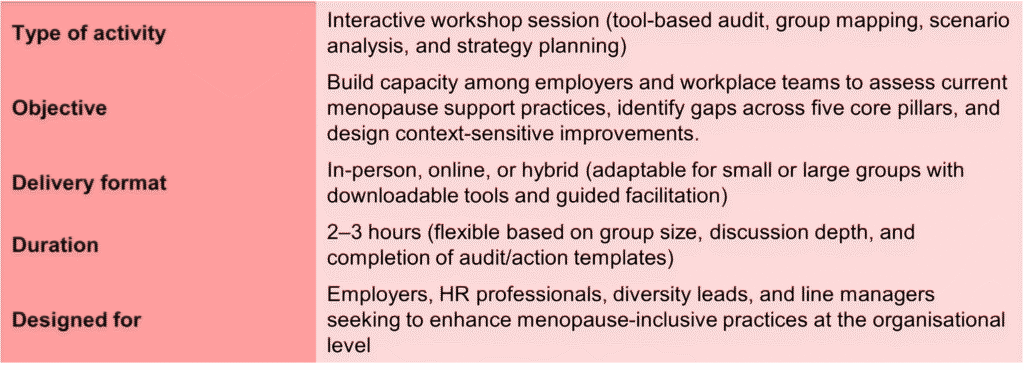
Description | Step 1: Introduction & Personal Reflection (20 mins) ●Read the short introduction in this module. ●Watch: ●Reflect: What are the biggest risks and barriers to menopause support in your workplace? Discuss in the group or make a note for yourself. Step 2: Audit Your Workplace: Mapping Demands & Resources (30 mins) ●Open the Audit & Action Planning Tool. ●Complete Part 1: Menopause Workplace Support Checklist. For each item, mark Yes / No / Needs Improvement. ○Items are grouped under practical workplace areas (e.g., Job Demands, Practical Support, Policies, Training & Awareness). ●Why: You’re using the audit to see which job demands (stressors) and resources (supports) affect menopausal employees, this links to the Job Demands-Resources (JD-R) and Salutogenic models. ●Tip: Use the EMAS Menopause at a Glance infographic for a summary of workplace priorities.. Step 3: Learn from Practice & Examples (25 mins) ●Read Case Study 22: Partille Municipality (from the Training Pack). ●Reflect: What did this workplace do well? What could be adapted to your setting? ●Optional: Watch NHS: Menopause Support: Workplace Conversations Step 4: Identify Priorities for Improvement (25 mins) ●Review your Menopause Workplace Support Checklist results. ●Spot the patterns: Are most “gaps” in a particular workplace area (e.g., support, awareness, policy)? ●Think: Improving which area would most help your colleagues? ●Note: Grouping your findings using the 5 Pillars overview will give you extra clarity. Step 5: Action Planning (25 mins) ●Draft one concrete action to improve menopause support in your workplace using Part 2: Menopause Workplace Action Plan Template (with Sample Objectives & Actions) in the tool. ●Examples: “Add menopause info to the induction process” or “Raise awareness in the next team briefing.” ●Decide: Who else could support or champion the change? Is this a team or leadership issue? ●Link: Consider how your action reduces job demands or increases resources, or builds a more salutogenic (healthy, meaningful) environment. Step 6: Review & Pledge (20 mins) ●Reflect on how your understanding of workplace menopause support has changed. ●Make a pledge: Commit to one realistic step you’ll take in the next 30 days. ●Share your idea with a peer, or keep it as your private commitment. Key Concepts: ●Why menopause support matters in the workplace ●The Job Demands-Resources (JD-R) model and Salutogenic (health-promoting) approach ●How to spot workplace risks and resources that impact menopause experience ●Practical action planning and small changes for real improvement ●(Optional) 5 Pillars framework, as an organising tool for your reflection and results |
Duration | 2-3 hours (flexible based on discussion and group size) |
Required materials | ●Slideshare Presentation Slides: “Being Menopause Friendly” Garlick & Baughurst Slide Deck Note Well: Slide 6: Overview of the 5 Pillars (Policy, Engagement, Training & Awareness, Support, Environment) ●Menopause Workplace Support: Audit & Action Planning Tool: Includes the detailed checklist grouped by core areas and mapped to the 5 Pillars ●Activity Instructions and Template |
Facilitator tips | ●Foster a safe, respectful space for open discussion. ●Encourage sharing of different perspectives and experiences. ●Be prepared to address sensitive topics with empathy and clarity. ●Emphasise practical application and real-world relevance. |
Adaptations and variations | ●For live sessions: use breakout groups where relevant and interactive discussions. ●For small organisations: Simplify the mapping and action plan exercises. ●For different audiences: Tailor examples and scenarios to fit participants’ roles and workplace contexts. |