Topic 3 Training Content and Delivery Guide
Description

Step 1: Engage with the Webinar (45 mins)

Step 2: Deepen Understanding of Frameworks (30 mins)

  • Actively use both the webinar and the accompanying Webinar Viewing Guide & Framework Mapping Table as your core learning materials. The video and guide together introduce and contextualise the three frameworks with real workplace examples.
  • Engage with provided discussion prompts (as an individual, in a group, or via online polls) such as:
  • Which framework most resonates with your experience?
  • Can you think of a time when workplace support or lack thereof influenced outcomes?
  • How do cultural norms or procedural supports in your workplace align with or challenge these frameworks?
  • For groups: Use tools like Slido to match frameworks to actual or illustrative cases.

Step 3: Reflect Personally (30 min)

Move to the Personal Reflection Worksheet: Menopause, Inclusion, and the Workplace .

  • Use this worksheet to explore your own role, feelings, and observations. It’s suitable whether you’re working solo or sharing reflections in a peer group.
  • Focus on how your insights from the webinar and frameworks shape what you see or could do in your workplace.

Step 4: Assess Organisational Climate (30 min)

  • Use the Workplace Inclusion Checklist. This structured tool assesses your organization’s (or team’s) current maturity against the three frameworks.
  • Complete the checklist after personal reflection, alone or as a group, and discuss results to identify both strengths and areas for growth.
  • Use outcomes to suggest targeted improvements or as a basis for action planning.

Step 5: Case Study Analysis: What Happens When We Act (or Don’t)? (35 min)

Step 6: Personal Role Reflection: What Can I Do? (20 Min)
Access the worksheet: Menopause, Inclusion, and the Workplace
Ask participants to:

  • Identify one barrier they observe or experience in their role
  • Make one specific, achievable commitment (e.g. “Raise menopause during our next team health check-in”)

Step 7: Wrap-Up & Next Steps (15 min)

  • Take a moment to identify one idea, insight, or perspective from this session that changed how you think about menopause at work.
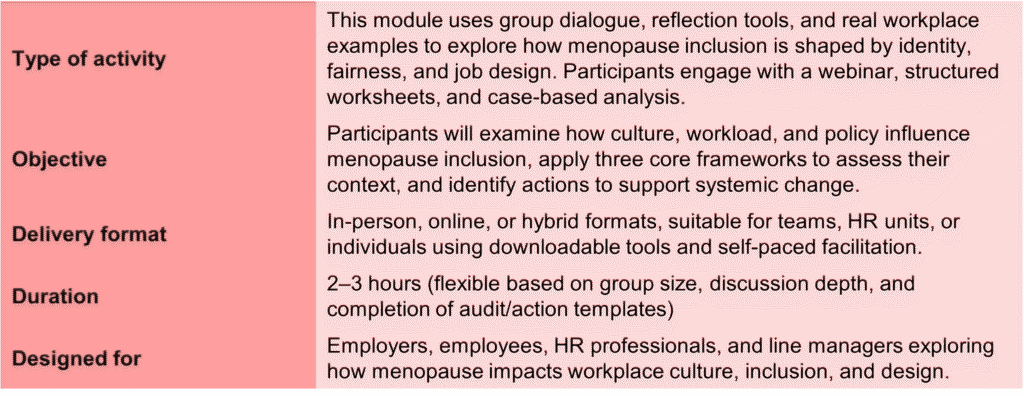
  • This step reinforces that menopause inclusion is shaped by culture, workplace design, and fairness, not just individual experience. Encourage participants to note something they want to reflect on, raise in conversation, or apply in their own context.

Call to Action: What’s one conversation you could start next week?

Key Concepts to Reinforce:

  • Menopause is a workplace design issue, not just a health issue
  • Silence sends a message; stigma thrives where conversation is absent
  • Trust and fairness matter more than perfect policy
  • Menopause belongs in leadership, retention, and DEIB strategy
Required materials
  • Webinar Recording:
    Menopause Awareness & Solutions: Empowering Employees via First Practice Management
    Watch The Webinar
    Note Well: Use alongside the Webinar Viewing Guide & Framework Mapping Table for targeted Time Stamps.
    Access the guide here
  • Personal Reflection Worksheet: Menopause, Inclusion, and the Workplace
    Encourages individual insight and workplace application.
    Download Worksheet
  • Workplace Inclusion Checklist
    A practical tool to assess organisational strengths and identify areas for improvement.
    Access Checklist

Case Study Analysis: Menopause Inclusion Case Studies: NHS England & SAP Germany

Facilitator tips

To ensure an engaging and effective session, consider the following best practices:

  • Use plain, inclusive language, avoid jargon.
  • Foster a safe, respectful space for open discussion.
  • Encourage sharing of different perspectives and experiences.

Adaptations and variations

To tailor this module to different audiences and workplace settings, consider the following modifications:

  1. Format Adaptations
  • Shortened Session: If time is limited, focus on key topics
  • Extended Workshop: For in-depth learning, expand the session into multiple modules with case studies and expert talks.
  1. Audience-Specific Customisation
  • For Employees: Focus on lived experience, psychological safety, peer support, and awareness.
  • For Managers and HR Teams: Focus on team dynamics, communication skills, and flexible working.
  • For Employers & Senior Leaders: Focus on strategic relevance, organisational culture, risk mitigation, and retention
  1. Industry-Specific Adjustments: This module can be adapted to specific sectors by adjusting language, examples, and group tasks to reflect real work environments and challenges.
  2. Accessibility Considerations
  • Provide closed captions for video materials and transcripts for presentations.
  • Offer content in multiple languages if needed.
  • Ensure flexibility for participants who may need breaks due to menopause-related symptoms.

By incorporating these adaptations, the session can be made more relevant and impactful for different workplaces and participants