Topic 2 Key concepts and Theoretical framework
Menopause Beyond Health:
Menopause in the workplace is not just a health issue, it reflects deeper institutional beliefs about:
- Who belongs
- Who gets support
- What ‘good work’ looks like
Many responses to menopause overlook structural factors, treating it as a private or individual matter.
This module introduces 3 frameworks to help us understand why menopause is often overlooked or mishandled:
- Social Identity Theory
- Job Demands–Resources (JD-R) Model
- Organisational Justice Theory
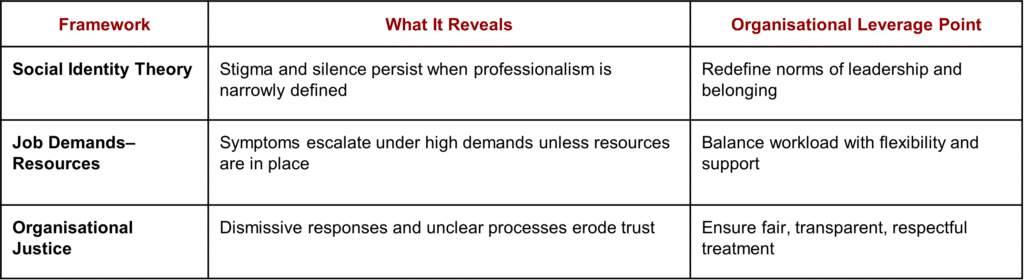
These models help uncover how policies, culture, and expectations shape inclusion, or exclusion, of menopausal workers.
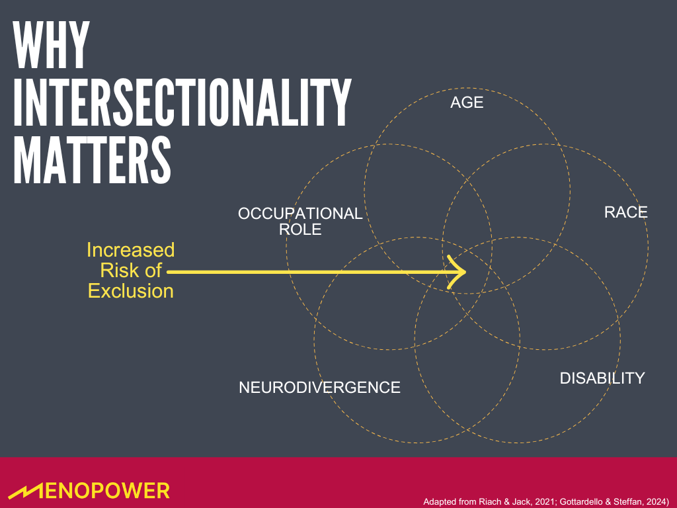
Why Intersectionality Matters
- Menopausal experiences are not one-size-fits-all, they are shaped by race, age, class, disability, and job role.
- Overlapping social identities create layered barriers to support, recognition, and fairness.
- Many workplace policies fail to account for these compounded challenges, reinforcing existing inequities.
- Employees from marginalised backgrounds may face greater stigma, less flexibility, and fewer disclosure options.
- New research highlights the needs of:
○Neurodivergent employees
○Lower-income or precarious workers
○Employees facing multiple axes of exclusion
Theoretical Lens #1: Social Identity Theory
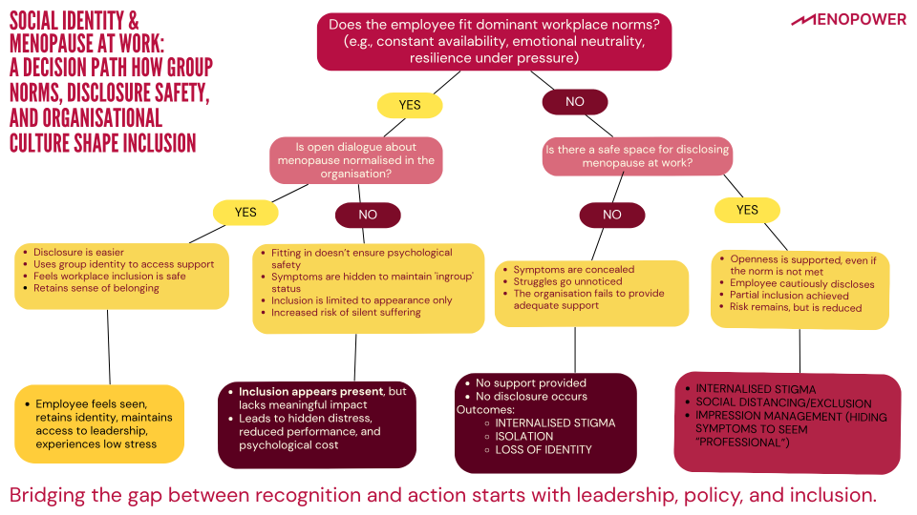
- We define ourselves, and others, by group memberships like age, gender, and job role.
- Menopausal employees may not fit dominant workplace norms:
- Constant availability
- Emotional neutrality
- Resilience under pressure
- This can lead to:
- Internalised stigma and reluctance to disclose symptoms
- Social distancing or exclusion from leadership roles
- Impression management (e.g., hiding symptoms to seem “professional”)
- True inclusion means challenging narrow definitions of professionalism at all life stages.
Theoretical Lens #2: Job Demands–Resources (JD-R) Model
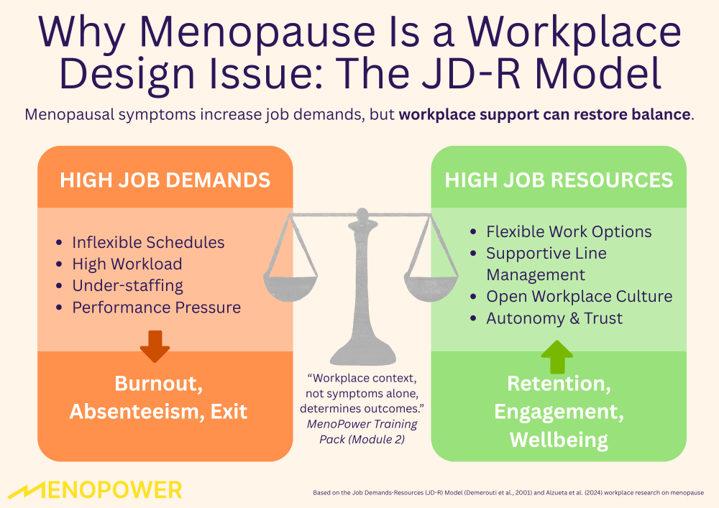
- The JD-R Model (Bakker & Demerouti, 2007) shows that all jobs include:
Demands – workload, emotional strain, time pressure
Resources – flexibility, autonomy, support - Menopausal symptoms add invisible demands that are often overlooked:
Fatigue
Sleep disturbance
Brain fog - Without adjustments, this imbalance leads to:
Burnout
Presenteeism
Reduced productivity
Workplace support makes a difference:
- Flexible hours or hybrid work
- Empathetic managers
- Peer networks that normalise disclosure
Key Insight:
Menopause is a workplace design issue, not just a personal challenge.
Theoretical Lens #3: Organisational Justice Theory
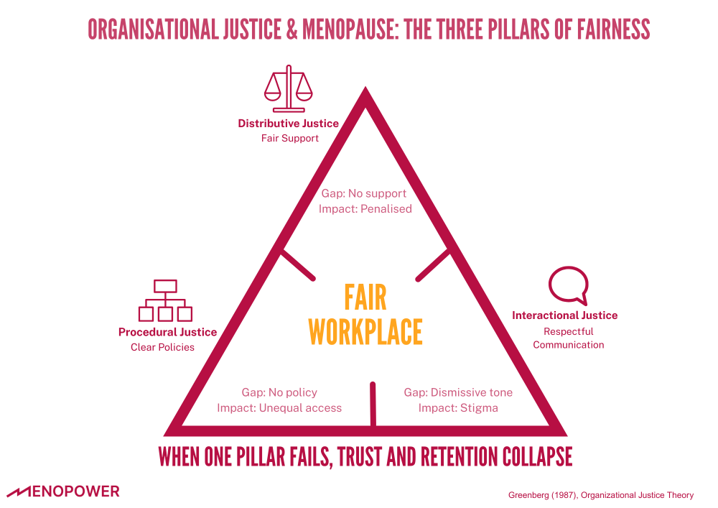
- Organisational Justice Theory (Greenberg, 1987) explains how fairness at work builds trust, motivation, and retention.
- When it comes to menopause, inclusion often falls short due to:
- Distributive injustice: Employees are penalised for lower performance without considering health impacts.
- Procedural injustice: Policies are unclear, inconsistent, or missing entirely.
- Interactional injustice: Managers respond dismissively or avoid the topic (e.g. “It’s just part of life, get on with it”).
Why it Matters:
- Fairness isn’t just about outcomes, it’s about being seen, heard, and treated with dignity.
- Inclusion improves when:
- Adjustments are available and transparent
- Conversations are respectful
- Policies ensure equal access to support
Key Insight:
Justice frameworks show that menopause inclusion isn’t a nice-to-have, it’s essential to organisational integrity and a strong employer-employee relationship
Framing Menopause as a Systemic Workplace Issue
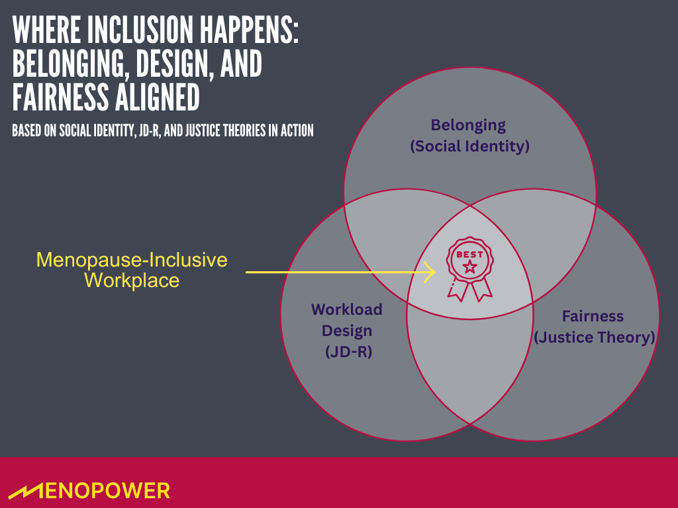
The three theoretical models we’ve explored show that menopause challenges are shaped not just by biology, but by culture, job design, and perceptions of fairness.
Takeaway Message:
These models help us move from blame or silence to systems-level change. Menopause inclusion isn’t individual accommodation, it’s part of workplace equity.
Optional Viewing: Embracing Menopause in the Modern Workplace
Estelle Solomons | TEDxMaude Street
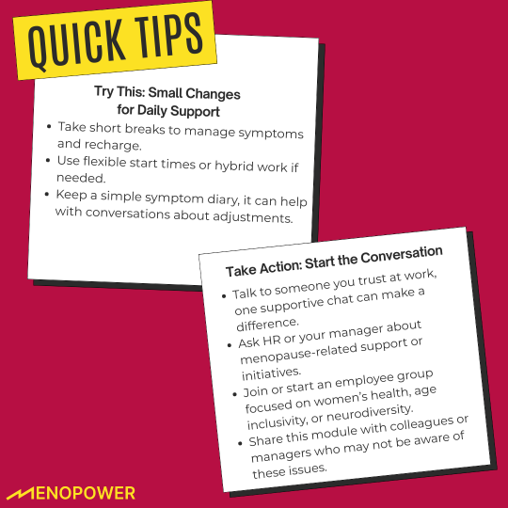
Before we move into real-world case studies and practical tips, take a moment to hear a lived experience perspective on why menopause at work matters, and what happens when organisations listen, adapt, and lead.
This TEDx talk challenges assumptions, highlights cultural barriers, and reinforces the message that inclusion is not just about policy, it’s about people.
NHS England: A Systemic Approach to Menopause Inclusion
Framework Highlighted: Organisational Justice Theory
What They Did:
- Developed a national Menopause Improvement Programme
- Delivered manager training, flexible scheduling, and
equitable access to occupational health support - Ran awareness campaigns to destigmatise menopause across NHS Trusts
Why it Matters:
- Aligns with distributive, procedural, and interactional fairness
- Promotes compassionate communication and clear support processes
- Signals menopause inclusion as core to workforce well-being, not an add-on
Case-in-Point:
At Sherwood Forest Hospitals NHS Foundation Trust, a research-based training intervention for managers led to improved staff wellbeing and a more supportive culture.
Legal Framing:
These initiatives align with legal obligations under:
- The Equality Act 2010 (protection against discrimination)
- The Health and Safety at Work Act 1974 (duty to safeguard wellbeing)
- Cited in ACAS (2023) guidance on menopause at work
Key Insight:
Fair, structured support improves culture, retention, and trust, especially when policies move beyond awareness to actionable equity.
SAP (Germany): Strategic Support by Design
Context: SAP, a global software company headquartered in Germany, embeds menopause support into its core wellbeing and inclusion strategy.
What They Offer:
- Flexible work arrangements
- Confidential support channels
- Health insurance covering menopause-related care
- Manager training on menopause-inclusive team planning
JD-R Application:
- Menopausal symptoms (fatigue, brain fog, mood changes) increase job demands
- Most performance systems fail to account for this invisible load
- What makes the difference are resources:
○Supportive managers
○Flexibility and autonomy
○Work environment control
Key Insight from van de Scheur (2022): When job resources increase, stress decreases, and employee engagement goes up.
Outcome: SAP’s approach turns inclusion into a daily design principle, not a side project. This reduces stigma, supports retention, and helps employees thrive throughout all life stages.
The Cost of Silence in the Private Sector
Framework Highlighted: Social Identity Theory
The Reality: When employers ignore menopause, the result is withdrawal, not resilience. Women disengage, reduce visibility, or quietly exit their roles.
Data Snapshot:
- Nearly 1 in 4 working women have considered quitting due to menopause symptoms
(Simplyhealth, 2023; Hoomph, 2024) - Many avoid disclosure, fearing they’ll be seen as unreliable or weak
Social Identity Theory Insight: When employees don’t match the dominant workplace norm (e.g. “always on,” emotionally neutral, high energy), they experience stigma, reduced confidence, and often self-exclude.
Consequences of Inaction:
- Missed promotions
- Poorer performance reviews
- Early exits, even from high-performing or leadership roles
- Unrecorded talent loss that undermines inclusion goals
Key Insight: This isn’t about individual weakness. It’s about organisational cultures that fail to adapt to the realities of midlife and aging.
From Theory to Action
What Needs to Happen Now
This module has shown that menopause is not just a private experience or a health issue. It’s a structural challenge shaped by:
- Organisational culture
- Leadership norms
- Workplace design
Why It Matters:
- Unacknowledged menopause symptoms lead to burnout, disengagement, and talent loss
- Silence perpetuates stigma — and pushes capable employees out
- Inclusion during midlife is as critical as inclusion at any other career stage
What Makes a Difference:
- Trained managers
- Inclusive, well-communicated policies
- Psychological safety to speak up without fear
- Recognition that support is not special treatment, it’s smart strategy
Key Insight: Menopause inclusion is not a bonus. It’s part of a retention strategy, a wellbeing strategy, and a workforce equity strategy.