Topic 1 Introduction and Context
By the end of this module, participants will:
1.Identify how menopause affects work dynamics, policy gaps, and inclusion in a relational and structural way.
2.Spot the impact of stigma and silence on how employees talk about menopause, or don’t.
3.Recognise how a lack of menopause support can lead to unfair performance evaluations and the loss of skilled employees.
4.Learn how to build a culture where menopause is acknowledged and respected.
Keywords:
Menopause, Organisational culture, Workplace accommodations, Inclusive workplace culture, Employee well-being, Diversity, equity and inclusion, Structural inequity, Ageism

Why Menopause Is a Workplace and Leadership Issue
- Menopause isn’t just a health concern, it’s a leadership and workplace culture issue.
- As more women remain in the workforce into their 50s and 60s, organisational support is essential.
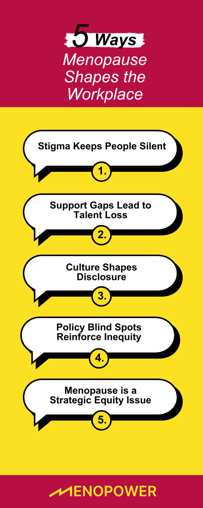
- Silence and stigma still dominate, affecting wellbeing, performance, and retention.
- Menopause challenges are shaped by how workplaces respond, not just by symptoms.
- Without supportive policies and open leadership, menopause becomes a hidden burden.
- Ignoring menopause risks losing talent, reducing engagement, and reinforcing inequality.
Why It Matters Now: The European Context
- Europe’s workforce is ageing, more women aged 45–64 are active in the labour market than ever before.
- Workplace support for menopause has not kept pace with this demographic shift.
- Menopausal women hold key roles across sectors, yet often lack support, leading to lower retention and missed inclusion opportunities.
- Addressing menopause at work is now a strategic priority for workforce equity, wellbeing, and sustainability.
- This is not just a health issue, it’s a demographic and economic imperative.
A Growing European Movement for Change
- The European Menopause and Andropause Society (EMAS) encourages employers to adopt menopause-inclusive policies through its Menopause and Work Charter, aiming to support employee wellbeing and retention.
- The European Agency for Safety and Health at Work (EU-OSHA) recognises menopause as a factor relevant to workplace health and safety.
- EU Directives such as 89/391/EEC (OSH) and 2006/54/EC (Equal Treatment) require employers to address psychosocial risks and prevent discrimination; while menopause is not explicitly mentioned, it is considered part of these broader protections.
- Some EU Member States, including Cyprus and Lithuania, are updating labour laws to protect older workers and promote gender equality.
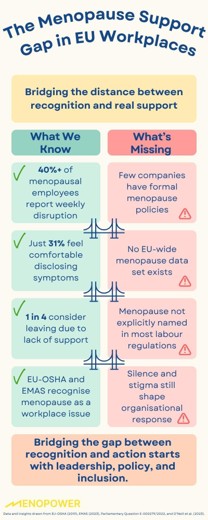
- Although no comprehensive EU-wide data on menopause in the workplace yet exists, momentum is building, providing employers with an emerging legal and ethical framework to guide action.
For more information on menopause-friendly workplace policies, visit the European Menopause and Andropause Society (EMAS) at European Menopause and Andropause Society | EMAS or check out these EMAS recommendations for conditions in the workplace for menopausal women.
Key European Union directives guiding workplace health and equality include the Occupational Safety and Health Directive 89/391/EEC and the Equal Treatment Directive 2006/54/EC.
The European Parliament’s written question E-000279/2022 highlights workplace menopause issues and discrimination policies: Read more.
Additional resources on occupational health can be found at the European Agency for Safety and Health at Work (EU-OSHA) website: osha.europa.eu.
Relevant Statistics & Research
- 40% of menopausal employees experience weekly disruption at work
○Fatigue (54%) and sleep disturbances (47%) most commonly affect focus, memory, and communication
(O’Neill et al., 2023)
- Only 31% of women feel comfortable discussing menopause at work
(Society for Women’s Health Research, 2021) - 1 in 4 working women have considered quitting due to menopause or menstrual symptoms
(Simplyhealth, 2023) - 17% have left or seriously considered leaving their job due to lack of support
(Alzueta et al., 2024) - Up to 50% may be quietly exiting or stepping back, even if not captured in HR data
(Royal London, 2023; Hoomph, 2023–2024) - Stigma, fear of judgement, and lack of formal policies contribute to:
○Missed promotions
○Poor performance reviews
○Increased attrition and burnout
Leadership & Organisational Responsibility
- Leaders shape culture, their openness or silence determines whether menopause is acknowledged or hidden.
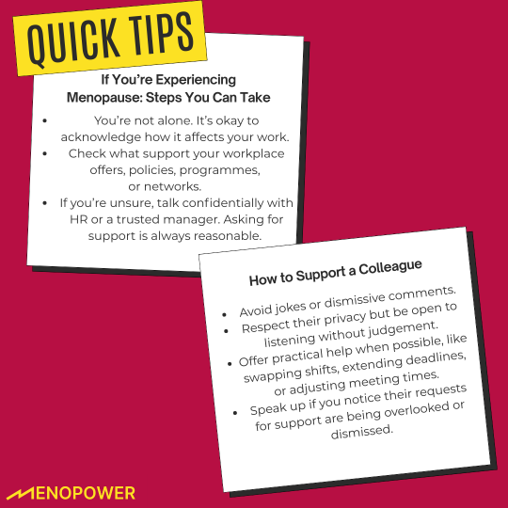
- Psychological safety starts at the top: managers who listen, learn, and respond empathetically create supportive environments.
- Inaction sends a message, when menopause is ignored, stigma thrives, and valuable talent may be lost.
- The UK’s Employment Rights Bill (2026) signals a broader European trend toward formalising workplace support for menopause.
- The time for action is now, organisations across Europe are recognising menopause as a strategic issue of inclusion, not a personal problem.